Jung Typology for Team Building The Essentials of Jung Typology for Effective Team Organization
Summary
This article is aimed to aid people at any level in an organization into better understanding themselves and those with whom they work. People in work environments who use typology as a systematic, workable, logical tool for individual and organizational development become more efficient, productive and, ultimately, financially successful.
By gaining an understanding of the theory and practice of typology, individuals become more familiar with their own personality and the personality types of others and gain insight into why people act and react the way they do. As this happens, an appreciation of the differences in others and the unique abilities that each personality has begins to grow. Ultimately, this leads to a more harmonious and productive work environment. The theory and practice of typology has its roots in the lifelong work of highly regarded researchers and practitioners such as Carl Gustav Jung, Isabel Briggs Myers and Katherine Briggs.
Contents
Type Preferences
According to Jung's psychological type theory, we are born with a predisposition for the functions and attitudes (orientation to the world) we will prefer to use as adults, and a predisposition toward how we will like to use them. We have four pairs of opposing attitudes and functions in total, and from each pair a preference toward one will develop. Due to this preference, we will use these attitudes more often and more naturally. They are more accessible to us and more comfortable to use. Over time, we tend to rely on these functions and attitudes and, as a result, they become stronger and more developed as we progress in life. Although our preferences come more easily, it does not mean that we cannot use and develop our other functions and attitudes when the situation demands. What it does mean, however, is that it will take more energy and concentration to use them and we will not have as much dexterity and skill when we do. Psychological preference does not represent an either/or concept. We are able to write with both hands, but prefer to use one above the other. It is important to remember that our preferences are dynamic and fluid, not cast in concrete. They relate to our selected way of behaving in most situations. The following are the criteria - preferences:
- Extraversion - Introversion
- Sensing - Intuition
- Thinking - Feeling
- Judging - Perceiving
The first criterion, Extraversion – Introversion, defines the source and direction of energy expression of an individual. The Extravert has a source and direction of energy expression mainly in the external world while the Introvert has a source of energy mainly in the internal world.
The second criterion, Sensing - INntuition defines the method of information perception of an individual. Sensing means that a person believes mainly information he or she receives directly from the external world. Intuition means that a person believes mainly information he or she receives from the internal or imaginative world.
The third criterion, Thinking - Feeling defines how a person processes information. Thinking means that a person makes a decision mainly through logic. Feeling means that, as a rule, he or she makes a decision based on emotion.
The fourth criterion, Judging - Perceiving defines how a person implements the information he or she has processed. Judging means that a person organizes all of the events in his or her life and acts strictly according to his plans. Perceiving means that he or she is inclined to improvise and seek alternatives.
The possible combinations of the criteria determine a type. There are sixteen possible types. Every type has a name (or a formula) according to the first letters in the combination of criteria (except iNtuition where the second letter "N" is used since Introversion also starts with "I"). For example:
- ISTJ: Introvert Sensing Thinking Judging
- ENFP: Extravert IN tuitive Feeling Perceiving
Type and Effective Teams
A team is an integral part of any organization. It consists of a group of two or more people working together to achieve a specific task or outcome. Now more than ever, team members need to work together effectively to accomplish tasks. As many teams are now cross-functional and self-directed, with no one person having direct authority over others, it is important to recognize and leverage the unique contributions that each type makes to a team. By understanding the different approaches, strengths and weaknesses of the type, the organization can improve team performance by leveraging team members’ natural strengths. Understanding these types, both of oneself and of others, can help team members open themselves to different perspectives and thus more effectively solve problems, resolve conflicts and improve collaboration and team cohesiveness. Analyzing the type composition of the team can help in identifying and addressing its deficiencies or "blind spots".
Team Type Distribution
Below is a summary of type distribution within a sample team. The numbers in parentheses represent the number of team members in the team sharing same type.
Sample Team Type Distribution
| ESTJ (1) | ISTJ (1) | ENTJ (4) | INTJ |
| ESTP | ISTP | ENTP | INTP |
| ESFJ | ISFJ | ENFJ (5) | INFJ |
| ESFP | ISFP | ENFP (1) | INFP (1) |
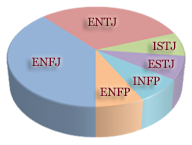
The predominant types in the sample team are ENFJ and ENTJ. Their strengths and weaknesses also apply to this team as a whole. Among the team's deficiencies in this example would be being down to earth, possessing quick orientation in unusual situations, and effective troubleshooting. These characteristics are the typical strengths of an ESTP, so adding an ESTP to the team would effectively address these "bling spots". It is important to understand each type represented within the team, and how a particular type behaves in a team environment. Understanding the differences in approaches to team work in different types helps the team members and leaders to establish effective collaboration and improve the overall performance of the team.
- Type distribution statistics and the pie chart are included in the JTPW™ Group Summary Report available to the users of Jung Typology Profiler for Workplace™ online assessment instrument free of charge.
JTPW™ Personality Radar and Effective Teams
Carl G. Jung’s type approach to personality has been successfully applied for the purposes of effective teaming. A commonly used method includes educating the team members about their Jungian Personality Type and its behavioral patterns and perception characteristics. This way, team members learn to understand what drives other people’s actions, as well as their values and goals. Understanding these aspects is a key factor to establishing effective collaboration among the team members and in enhancing team productivity.
This approach, although proven successful, still has practical limitations. These limitations are due to the substantial behavioral differences in individuals that can take place within the same Jungian type. Therefore, it is found practical and useful, to characterize the workplace-related and teamwork-related specifics of individual realization of the Jungian type, in the framework of the 5 core categories of behavioral qualities in addition to the traditional approach.
JTPW™ Personality Radar (or Personality Radar further in this article) is a graph that visually represents and summarizes the strengths of the workplace-related behavioral qualities (behavioral indices). These key workplace-related behavioral qualities can be grouped into 5 categories as follows:
| Category | Behavioral Qualities |
| Leadership | Power, Assurance, Visionary, Resourcefulness |
| Communication and interpersonal relations | Communication, Extraversion, Sociability |
| Empathy | Empathy and, to a certain extent, Sociability |
| Diligence | Conscientiousness, and, to a certain extent, Self-control |
| Rationality and Analyticity | Rationality |
JTPW™ Personality Radar is included in personality assessment reports available with Jung Typology Profiler for Workplace™ . JTPW™ Personality Radar can be effectively used for practical team building and career development purposes by practitioners even if they are not experts with Carl G. Jung's approach to personality.
The fundamental steps in effective team building include identifying the level of compatibility among team members as well as between the team and its leader.
When analyzing the Radars of two team members working together, we look for the qualities that are expressed at a similar level. The collaboration will be more effective in activities that are affected by the behavioral qualities with a similar level of expressiveness, because their approach to these work activities is going to be more cohesive.
For example, look at sample Personality Radar results Figure 1 Respondent A and Figure 2 Respondent B , below.
Respondents A and B will work in a consistent manner in activities requiring Conscientiousness, Assurance, Visionary qualities.
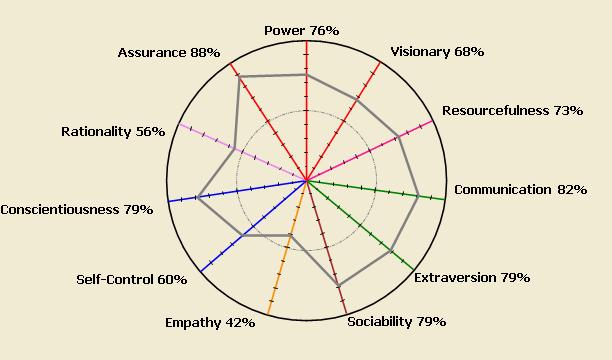
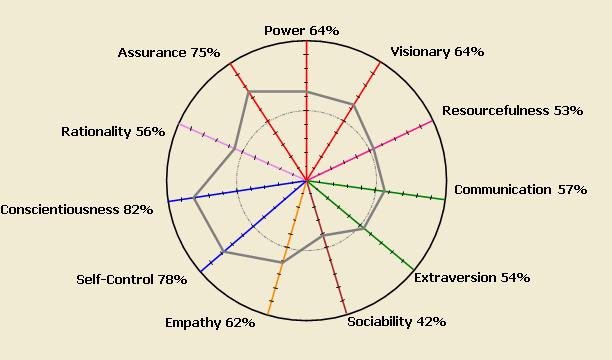
On the other hand, in work activities engaging personality qualities that have substantial differences in the level of expressiveness, the respondents should be put in or directed to strive for a mutually complimenting type of cooperation. E.g. each respondent should be focused on such tasks or activities which are most suitable based on the qualities that are more in line with their stronger qualities. Consider, for example, the same sample results, Figure 1: Respondent A and Figure 2: Respondent B, above. While on the same project, Respondent A should take initiative in such activities or task that require stronger Resourcefulness, Communication, Sociability qualities whereas Respondent B should be responsible for the aspects requiring stronger Self-control and Empathy qualities.
Next Steps
- For more examples of using Personality Radar for effective teaming please read JTPW™ Personality Radar for Team Building article.
- Click here to purchase JTPW Personality Assessments.
- Free trial is available to qualified customers.