JTPW™ Personality Radar for Team Building A Practical Application Guide
Summary
This guide provides examples and the best practices of using the JTPW™ Personality Radar graph for effective team building. The JTPW™ Personality Radar graph is included in personality assessment reports available with the Jung Typology Profiler for Workplace™. Target audience: team building coaches, workshop facilitators and practitioners. JTPW™ Personality Radar can be effectively used for practical team building and career development purposes by practitioners even if they are not experts in Carl G. Jung's approach to personality.
Contents
JTPW™ Personality Radar
JTPW™ Personality Radar (or Personality Radar further in this article) is a graph that visually represents and summarizes the strengths of key workplace-related behavioral qualities (behavioral indices). These key workplace-related behavioral qualities can be grouped into 5 categories as follows:
| Category | Behavioral Qualities |
| Leadership | Power, Assurance, Visionary, Resourcefulness |
| Communication and interpersonal relations | Communication, Extraversion, Sociability |
| Empathy | Empathy and, to a certain extent, Sociability |
| Diligence | Conscientiousness, and, to a certain extent, Self-control |
| Rationality and Analyticity | Rationality |
JTPW™ Personality Radar (or Personality Radar further in this article) is a graph included in personality assessment reports available with Jung Typology Profiler for Workplace™. JTPW™ Personality Radar can be effectively used for practical team building and career development purposes by practitioners even if they are not experts in Carl G. Jung's approach to personality.

JTPW™ Personality Radar and Team Building
Carl G. Jung’s approach to personality can successfully be applied for the purposes of effective team building. A commonly used method includes educating team members about their Jungian Personality Type and its behavioral patterns and perception characteristics. This way, team members learn to understand what drives other people’s actions, as well as their values and goals. Understanding these aspects is a key factor to establishing effective collaboration among the team members and enhancing team productivity.
This approach, although proven successful, still has practical limitations. These limitations are due to the substantial behavioral differences among individuals that can take place within the same Jungian type. Therefore, it has been found practical and useful to characterize the workplace-related and teamwork-related specifics of individual realization of the Jungian type within the framework of the 5 categories of the behavioral qualities defined in the previous chapter (above), in addition to the traditional approach.
Fundamental steps in effective team building include identifying the level of compatibility among the team members and between the team and its leader.
This can be achieved with side-by-side comparison of the Personality Radars of the participants. This includes two key aspects:
- Granular level: the pattern and expressiveness of individual behavioral qualities of the two Radar
- Category level: the pattern and expressiveness of the groups of behavioral qualities in each category (5 categories total).
Comparison of the Individual Behavioral Qualities
When analyzing the Radars of two collaborating team members, look for the qualities that are expressed at a similar level. Their collaboration will be more effective in the work activities that are affected by the behavioral qualities with a similar level of expressiveness, because their approach to these work activities is going to be more cohesive.
For example, look at sample Personality Radar results Figure 2 Respondent A and Figure 3 Respondent B, below.
Respondents A and B will work in a consistent manner in activities requiring Conscientiousness, Assurance, Visionary qualities.
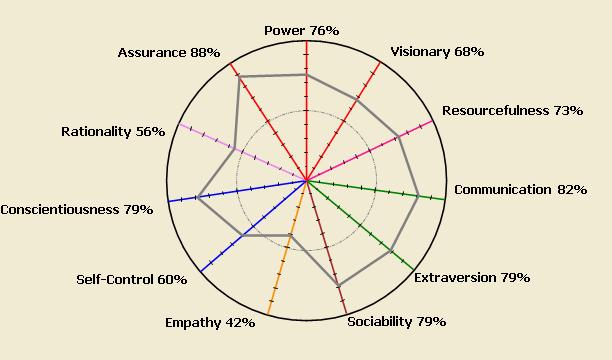
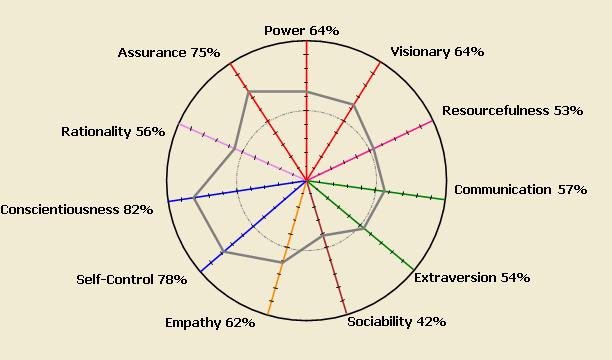
On the other hand, in work activities engaging those personality qualities that have substantial differences in level of expressiveness, the respondents should be put in or directed to strive for a mutually complimenting type of cooperation. E.g. each respondent will be focused on the tasks or activities that are most suitable to them, based upon qualities that are more in line with the stronger aspects of their personality. Consider, for example, the same sample results, Figure 2 Respondent A and Figure 3 Respondent B, above. While on the same project, Respondent A should take initiative in such activities or tasks that require stronger Resourcefulness, Communication, Sociability qualities; whereas Respondent B should be responsible for the aspects requiring stronger Self-control and Empathy qualities.
Comparison of the Behavioral Quality Categories
Leadership Qualities
Consider the following example below,Figure 4 Supervisor and Figure 5 Subordinate. The Supervisor possesses expressed Leadership qualities whereas the Subordinate possesses moderately expressed Leadership qualities. Therefore, in their interactions, the Supervisor will take a strong leadership role.


Team members with strong leadership qualities may also be present in the team. Consider another team member, Figure 6 Subordinate 2. This subordinate possesses overall more expressed Leadership qualities than the Subordinate from the previous example (Figure 5 Subordinate). Therefore, in such cases, the Supervisor may want to try to leverage this situation, e.g. by delegating more responsibility or encouraging more initiative in some areas.
Two individuals with strong leadership qualities may compete over a leadership role in the team. In some cases, such competition may become adversarial and negatively affect the overall team cohesiveness and performance.

Diligence Qualities
Consider Figure 5 Subordinate. The team member’s Diligence-related qualities (Conscientiousness at 82% and Self-Control at 75%) predominate over the rest. Note that team leader’s Diligence qualities are not as expressed (Figure 4 Supervisor). The team leader may be advised about this strong area of the subordinate so that he/she can leverage it in accomplishing functional tasks and in order to learn to complement each other in achieving common goals rather than arguing over different points of view.
Empathy Qualities
Consider Figure 6 Subordinate 2 who possesses expressive Empathy as opposed to the Figure 4 Supervisor. In this case, the Supervisor, by knowing that Empathy is not his strongest quality, may want to have this subordinate engage in matters requiring more empathy (e.g. customer service tasks or the support of other team members), or to obtain this subordinate’s opinion about certain actions in order to broaden the supervisor’s own perspective.
People who score high in Empathy should learn not to be upset when they interact with individuals with a low score in Empathy and do not receive warm responses.
Often, people who score high in Empathy become the consolidating “glue” within the team thanks to their ability to understand the concerns and feelings of others.
Communication Qualities
Review the group of qualities of Communication and Interpersonal relationships (Communication, Extraversion, and Sociability) to see if there are any communication deficiencies within the team, and pay attention to the level of the relative differences. The deficiency in Communication skills results in a lack of understanding among the team members.
The deficiency in Sociability may be an obstacle interfering with effective delegation and collaboration. Consider Radar data in Figure 5 Subordinate where Sociability is a low 18%. As a rule, such people prefer working independently and avoid delegation to or the involvement of others.
Rationality and Analytical Thinking Qualities
Pay attention to the level of relative difference in the Rationality of the team members. Substantial differences on Rationality scale may result in substantial divergence in how team members see the current situation and its development. This is particularly evident when one member’s Rationality is below the median whereas another’s is above.
Blind Spots
Look for and be aware of group “blind spots” (group-level weaknesses), based on Radars of individuals in the group. For example, consider a group consisting of Figure 4 Supervisor and Figure 5 Subordinate. Both possess lower than median Empathy and this means the chance of both of them (as a group) having difficulties in establishing a warmer, more humane relationship with others at work is higher.
It is possible to obtain Group Personality Radar representing the group as a whole and showing the areas of strengths and deficiencies of the group. For instance, Figure 7 Group Personality Radar Example reveals sociability deficiency of the group.
